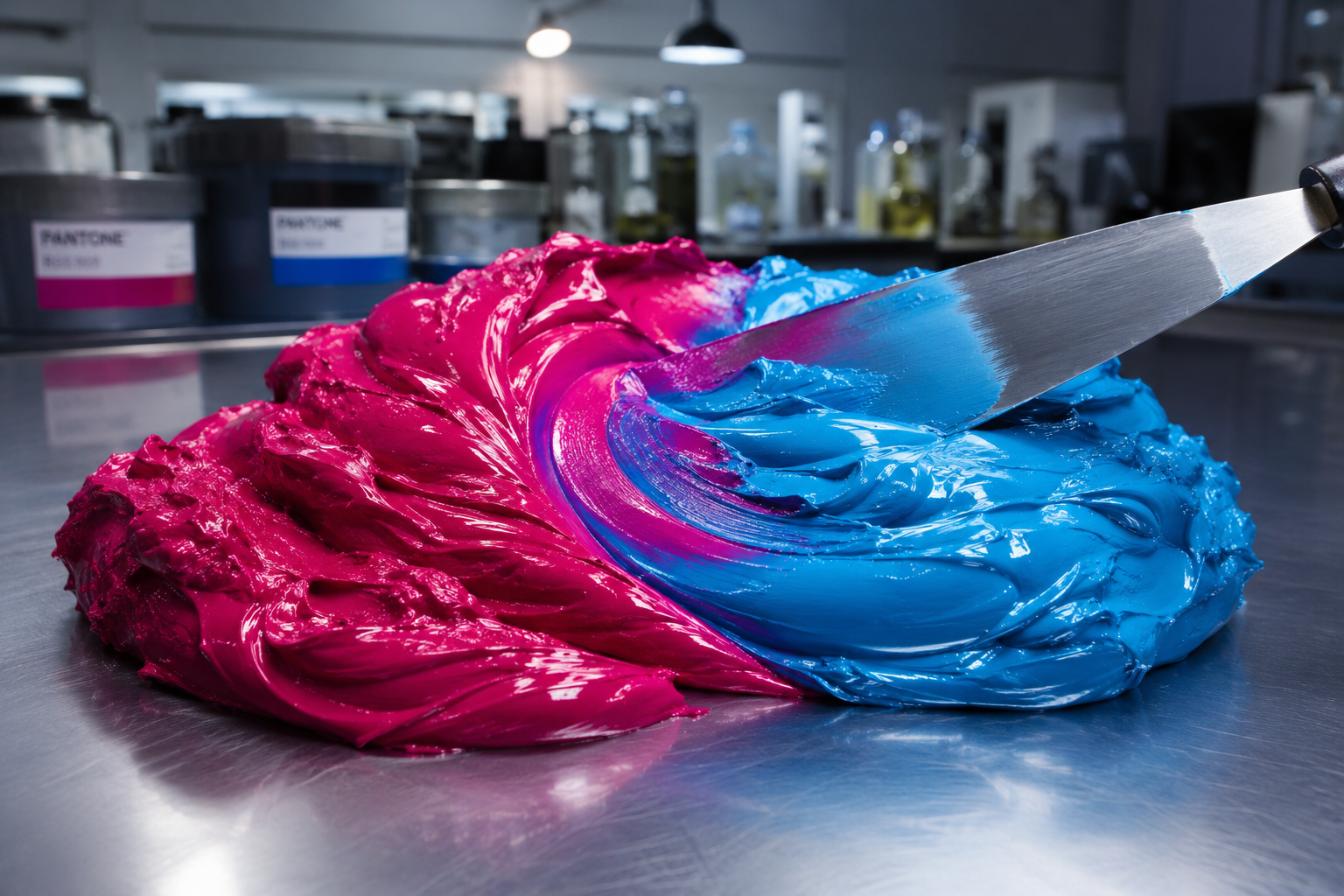
Offset printing inks are specifically formulated for offset presses.
To perform effectively, they must withstand the chemical reaction with the fountain solution on the dampened offset plate.
Achieving optimal print quality requires preventing two critical failures: water-in-ink emulsification, where the ink absorbs water, and ink-in-water emulsification, where the ink breaks down into the fountain solution on non-printing areas.
These emulsification problems severely impair the ink’s body, color, and drying qualities, ultimately causing tinting on the non-printing areas of the plate and printed sheets.
Furthermore, due to the split-film action of lithography printing—where the offset blanket transfers only a portion of the ink from the printing plate to the paper/cardboard—the final ink film is exceptionally thin.
Therefore, the ink must carry its full intended color and opacity despite this thin film application.
Chemical Composition of Offset Printing Inks
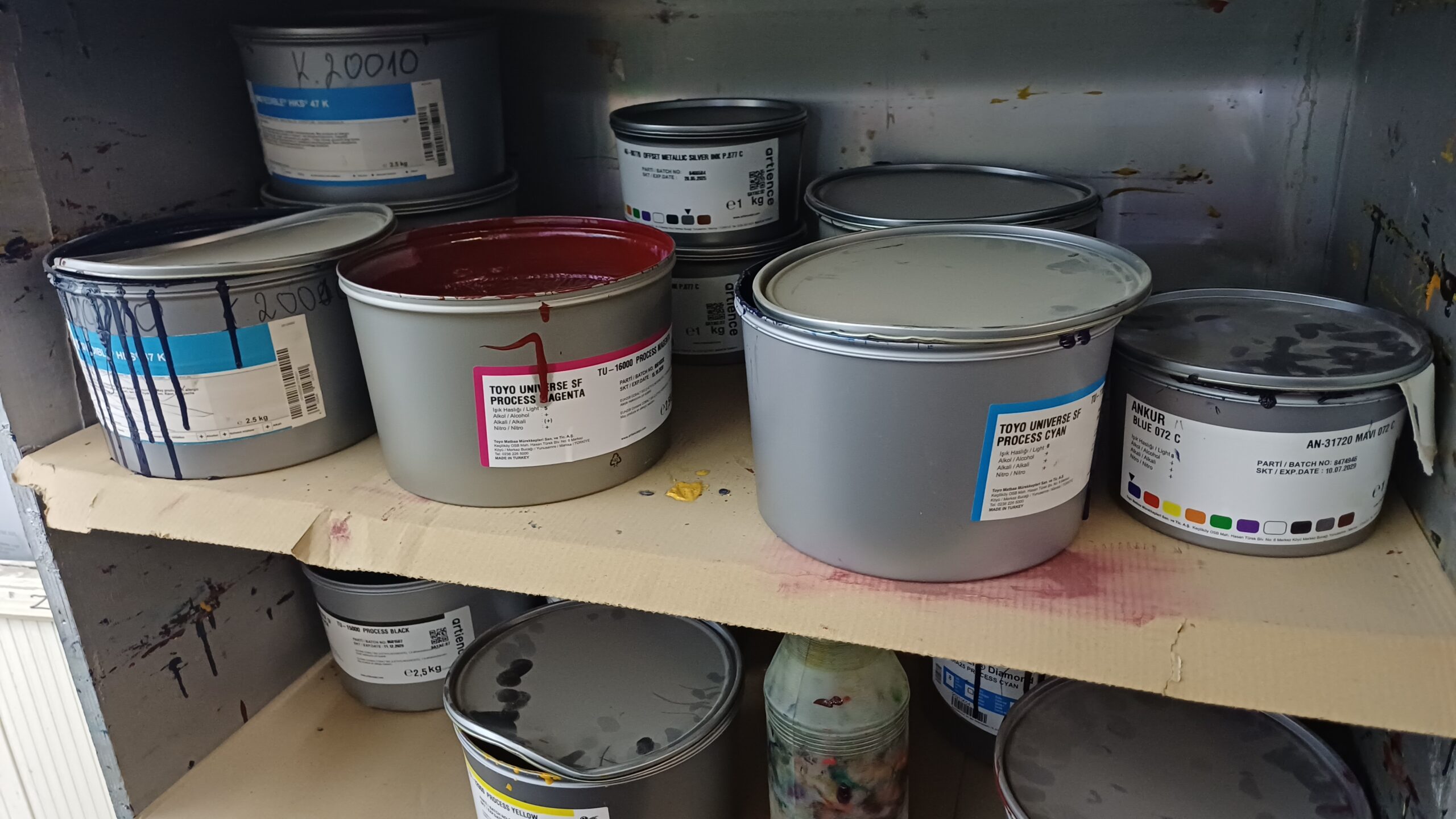
Offset printing inks are made of three main ingredients:
Pigment – the coloring material in the ink.
Vehicle – the liquid that holds the particles of pigment.
Modifiers – additives that control the drying of the ink as well as other factors such as smell, scuff resistance, and fading.
Pigments
Black ink typically uses organic pigments made from carbon.
Colored inks rely on inorganic pigments that are created by mixing chemicals.for example, combining sulfur, silica, or kaolin with soda or sulfate salts produces ultramarine blue ink.
For example, sulfur, silica, or china clay can be combined with either soda ash or sulfate salts to make ultramarine blue ink.
Vehicles
Vehicles act as the liquid that holds the pigment particles together and carries them to the paper/cardboard.
There are two kinds of vehicles used in offset inks:
– Oils such as soya oil or linseed oil (which is a yellowish oil made from flax).
-Synthetic vehicles that are created from chemical mixtures, like phenolic resins made by combining phenol and formaldehyde.
Modifiers
Modifiers are ingredients added to the ink to control drying and other qualities such as smell and resistance to fading.
Visual and Optical Properties of Offset Printing Inks
The visual properties of an ink, including color, transparency, opacity, and gloss, depend greatly on the relationship between the pigment and the vehicle system.
While black is the most commonly used color, cyan, magenta, and yellow are essential for process printing to create millions of different shades.
Since color comes from reflected light, the ink film acts as a filter on the light reflected from the substrate; a red ink film, for example, transmits the red portion of the spectrum while blocking the rest.
The color of the substrate and its absorption properties will also significantly affect the final visible color.
Thus, various ink colors printed individually or “trapped” one on top of the other create different filter effects resulting in different visible colors.
Similarly, these same ink colors printed on different substrates will result in visible colors that are different yet.
Ink color
It is the term that is most commonly used when talking about hues or shades of offset printing inks – whether the ink is red, blue, green or purple.
Secondarily, we can describe its strength or saturation, also called chroma.
Thirdly, we can indicate how light or dark it is – which refers to its purity or value.
The amount of pigment used affects the strength of the ink color, and the type of carrier used can affect both the hue and value of the ink color.
The color of the carrier itself, its ability to wet pigmented objects, and even the chemical interaction between the carrier and the pigment can all affect the hue or purity.
Finally, the color of the substrate being printed on and its drying/absorbing properties affect the results of color printing.
Opacity
The ability of the ink to hide the base color.
Opacity is physically tested by applying an ink sample with a knife over the printed black line and comparing the coverage to an established standard.
Transparency
Key to full-color printing, transparent inks don’t hide base colors, but mix with them to create third colors.
The choice of color and its dispersion through the carrier dictates the degree of transparency.
Gloss
The ability of ink to reflect light, depending on the smoothness of the ink film applied to the substrate to be printed on.
Higher carrier-to-ink ratios and thicker ink films generally produce higher gloss, while high substrate penetration reduces gloss.
Runnability and Rheology on Press
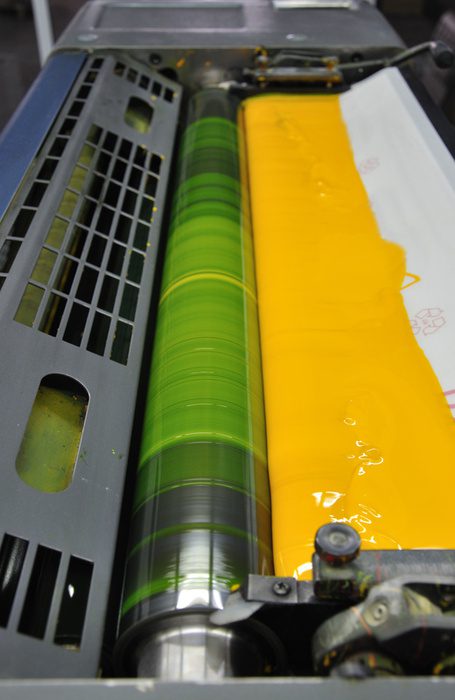
Runnability is a term unique to printing.
It applies to the trouble-free interaction between the ink and the press, the paper and the press, and finally, the ink and paper.
Body, temperature stability, length, tack, adhesion and drying all contribute to the runnability of an ink and are primarily a function of the vehicle system used in the ink.
Body and Viscosity
Body refers to the consistency (stiffness or softness of an ink).
Viscosity is a related term that refers to the flow characteristics of soft or fluid inks.
Ink body and viscosity requirements vary widely by printing process.
In general, letterpress and offset printing inks are fairly thick or “viscous” (much like paste or honey).
On press, they move through a series of rollers called the ink train where the action of the rollers spreads the ink into a thin film for transfer to the blanket and/or plate and onto the substrate.
Temperature stability of offset printing inks
Ink vehicles must withstand the heat generated by the friction of rotating rollers.
Insufficient stability negatively impacts the ink’s body and runnability.
Length
The tendency of an ink to form threads when stretched. Offset inks are generally long, meaning they stretch far without breaking.
However, excessively long inks can sling or mist on high-speed presses, while short inks (with a butter-like consistency) flow poorly and build up on rollers.
Tack
It refers to the stickiness of the ink, and it must be correct so that the ink will stick to the rollers of the press and not fly off, but still transfer from roller to roller, from roller to plate, from plate to blanket, and from blanket to paper.
Advanced Drying Mechanisms
Proper drying is critical for post-press handling, reducing air pollution, and improving pressroom productivity.
The initial phase is setting, where the liquid portion evaporates or penetrates the stock, causing the ink to thicken.
This is followed by actual drying through specific mechanisms:
Absorption: Used for porous substrates like newsprint and corrugated board, where the liquid vehicle penetrates the substrate, leaving the solid ink film on the surface.
Oxidation: Components in the ink oils chemically combine with atmospheric oxygen to form a solid film.
This is often accelerated by chemical driers, heat, or infrared radiation.
Evaporation: Utilized for non-porous substrates (plastics, glass) where rapid solvent evaporation leaves resins to bind the pigment.
Evaporation must be fast enough for drying but balanced to avoid on-press instability.
Polymerization: Found in radiation curing (UV or Electron Beam).
All ink components remain on the substrate and harden into a film via a chemical reaction triggered by energy.
UV-curable inks require a photo-initiator, whereas EB-curable formulations do not.
Precision Color Matching (PMS)
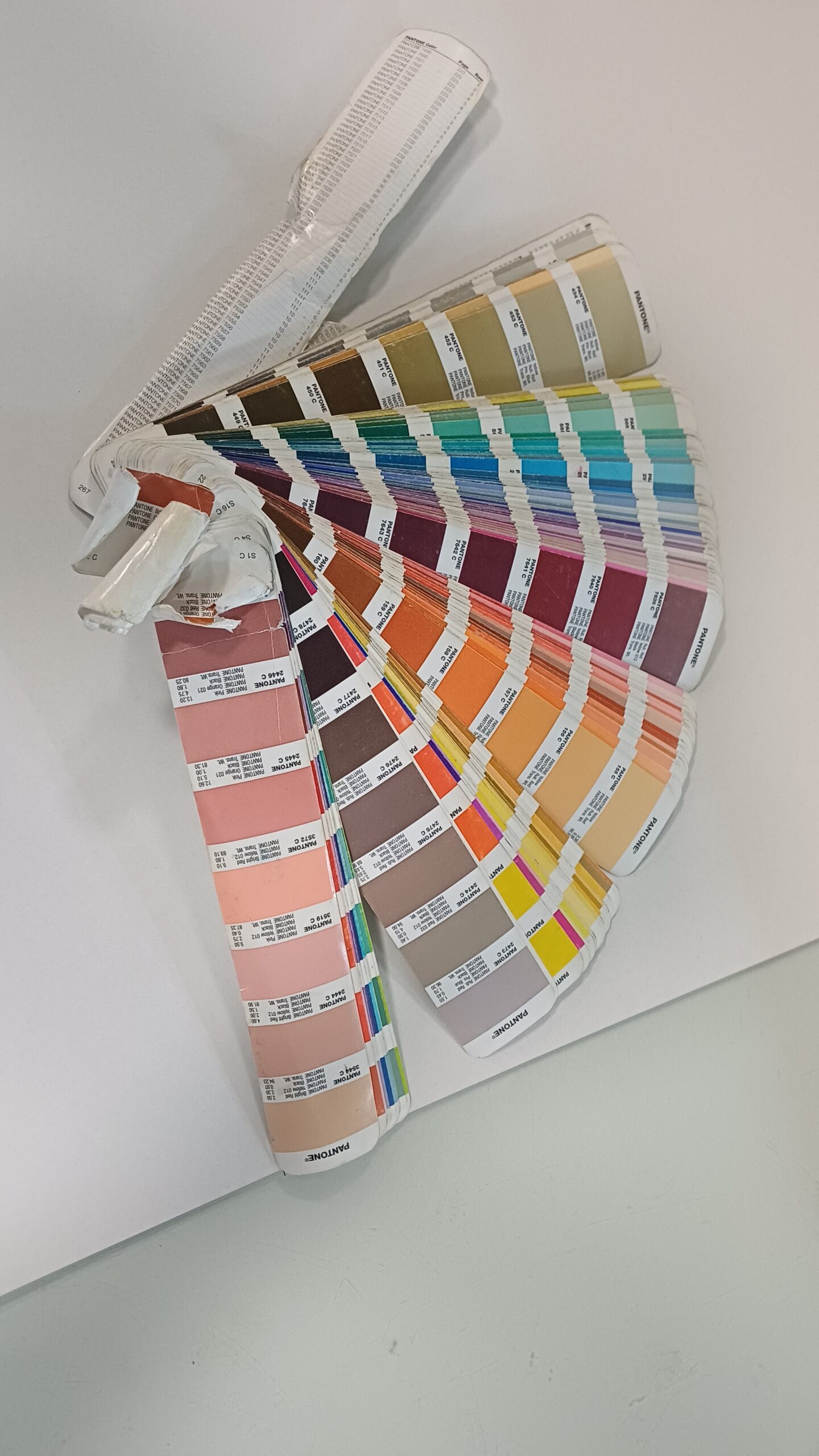
To accurately mix specific desired colors (such as a specific yellow-green), the printing industry relies on the PANTONE MATCHING SYSTEM (PMS).
This system consists of swatch books containing hundreds of color samples, each identified by a specific code number and formula.
The PMS system relies on ten basic colors: PMS black, white, ruby red, rhodamine red, warm red, reflex blue, process blue, green, violet, and yellow.
Essential Ink Terminology Lexicon
| Term | Technical Definition |
|---|---|
| Permanent Inks | Inks that maintain color and resist fading under sunlight exposure (also called “fast” inks), suited for outdoor signs. |
| Fugitive Inks | Inks that tend to lose color and fade upon long sunlight exposure. |
| Resistant Inks | Inks engineered to withstand gases, chemicals, heat, moisture, or physical scuffing. |
| Toners & Lakes | Toners are highly concentrated, strong colors, whereas Lakes are body colors that are not particularly bright. |
| Job vs. Halftone Black | Job black is an inexpensive ink for ordinary jobs, while halftone black is specifically engineered for printing small dots in halftones. |
| Metallic Inks | Inks made with metal powders, such as bronze for “gold” and aluminum for “silver”. |
| Process Inks | The base colors for full-color work: Process Yellow, Process Magenta (red), Process Cyan (blue), and Process Black. |
Frequently Asked Questions (FAQ) – Offset Printing Inks
What causes ink emulsification on an offset press?
Ink emulsification occurs when the delicate chemical balance between the ink and fountain solution is disrupted. Water-in-ink emulsification happens when ink absorbs excess water, while ink-in-water emulsification occurs when the ink breaks down into the fountain solution. Both conditions severely impair ink body, color density, and drying.
What are the main chemical components of offset printing inks?
Offset ink consists of three primary ingredients: pigments (the organic or inorganic colorants), the vehicle (the liquid carrier, such as linseed oil or synthetic resins, that holds the pigment), and modifiers (special additives that control drying rates, scuff resistance, and odor).
Why is ink “tack” so important for press runnability?
Tack refers to the stickiness of the ink. It must be perfectly calibrated so the ink adheres to the rotating press rollers without flying off (misting), while still allowing for a smooth, uniform transfer from the roller to the plate, onto the blanket, and finally to the substrate.
How do offset printing inks dry on non-porous materials?
On non-porous substrates like plastics or glass, inks cannot dry via absorption. Instead, they dry through evaporation (where solvents rapidly evaporate leaving binding resins behind) or through polymerization (where UV or Electron Beam energy triggers a chemical reaction that hardens the ink into a solid film).