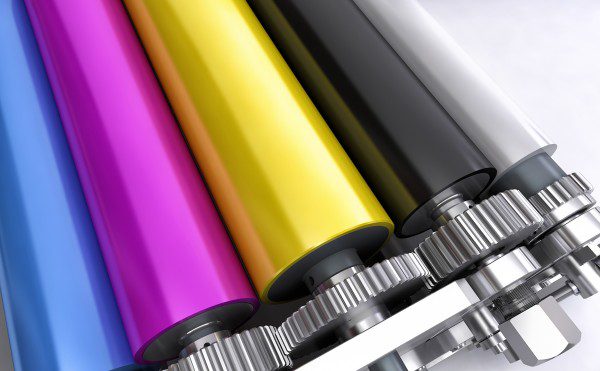
In offset printing, rollers are the primary mechanical elements responsible for the continuous, microgranular transfer of offset ink and dampening solution.
The structural integrity, chemical formulation, and physical calibration of these rollers directly dictate the sharp resolution of the printed halftone dot and the overall efficiency of the printing process.
Achieving high print quality requires a deep understanding of roller polymer chemistry, durometer dynamics, and precise mechanical adjustments.
The Chemistry of Offset Rollers: Polymers, Plasticizers, and Vulcanization
Modern offset printing rollers are constructed from synthetic rubber elastomers – a highly sophisticated blend consisting of raw base rubbers mixed with cross-linking agents, fillers and specialized chemicals.
The base elastomer determines the material’s basic resistance to swelling, chemical degradation and mechanical wear.
Selecting the right base material is crucial to balancing specific printing requirements:
NBR (Nitrile Butadiene Rubber): The industry standard for conventional oil-based ink systems.
NBR offers exceptional resistance to aliphatic hydrocarbons and typical washdown fluids, but swells rapidly when exposed to UV monomers.
EPDM (Ethylene Propylene Diene Monomer): Particularly used for UV-curable and LED-UV printing.
EPDM exhibits high resistance to aggressive polar solvents and photoinitiators found in UV inks, although it degrades rapidly when exposed to conventional mineral oils.
Polyurethane (PU/TPU): Provides unparalleled mechanical resistance to wear and tear.
Ideal for fast, long-term applications, although it can be sensitive to very aggressive solvents and elevated temperatures.
Silicone: Chosen primarily for its extreme heat resistance (up to 260°C) and excellent ink release properties, although it has lower inherent resistance to abrasion and tearing.
The transition from a raw, plastic compound to a highly elastic, stable matrix is achieved by vulcanization.
During this thermal process, vulcanization agents (such as sulfur or peroxides) induce chemical cross-linking between the polymer chains.
In order to modulate the final elasticity, plasticizers (liquid oils) are integrated into the mixture.
The volumetric ratio of the plasticizer determines the subsequent structural hardness: higher concentrations give a more flexible, softer rubber matrix after vulcanization, while lower concentrations maintain a rigid, high-density structure.
Shore Hardness Dynamics and Durometer Verification
The mechanical resistance of a roller surface to structural penetration is classified as its Shore hardness.
This feature is determined with the use of a calibrated Shore durometer, which applies a standardized spring force (usually 1 kp) to press a needle into the rubber surface of roller for exactly three seconds time.
Shore A scale: is a method used to show us or to characterize the resistance of a material to localized deformation or indentation.
This scale is universally applied for measuring flexible, soft to medium-hard rubber compounds that are usually used in inking and dampening rollers.
Shore D scale: This scale is used when measuring materials of high density and stiffness, such as hard distributor or sliding rollers found inside an offset press.
Dynamic Hysteresis Phenomenon: It is crucial for offset press operators to understand that the Shore hardness of rollers is temperature dependent.
During high-speed production, rollers undergo rapid, cyclic compression and decompression, creating an internal kinetic friction known as “hysteresis”.
This dynamic heat buildup expands the rubber matrix of the rollers, causing the roller to soften during operation.
Therefore, durometer measurements must always be performed at a standardized ambient base temperature (20°C to 23°C) to prevent inaccurate results.
Technical Specifications: Durometer Measurement
To maintain a stable ink-water balance and prevent ink emulsification, for rollers in offset printing we must use precise durometer specifications adjusted to the specific ink chemistry and dampening configuration:
| Roller Classification | Ink/System Application | Surface Property | Target Shore Hardness |
|---|---|---|---|
| Inking Form / Distributor | Conventional Oil-Based Inks | Oleophilic (Oil-Friendly) | 30° – 35° Shore A |
| Inking Form / Soft Transfer | UV / LED-UV Curable Inks | Oleophilic (Monomer Resistant) | 25° & 40° – 45° Shore A |
| Dampening Form / Metering | Alcohol / Continuous Systems | Hydrophilic (Water-Friendly) | 25° – 30° Shore A |
| Direct Dampening Form | Conventional Direct Dampening | High Hydrophilicity | Hard Rubber / High Durometer |
Note: Utilizing an NBR roller within a UV printing setup, or vice versa, triggers critical compound swelling, immediate plasticizer leaching, and premature surface degradation.
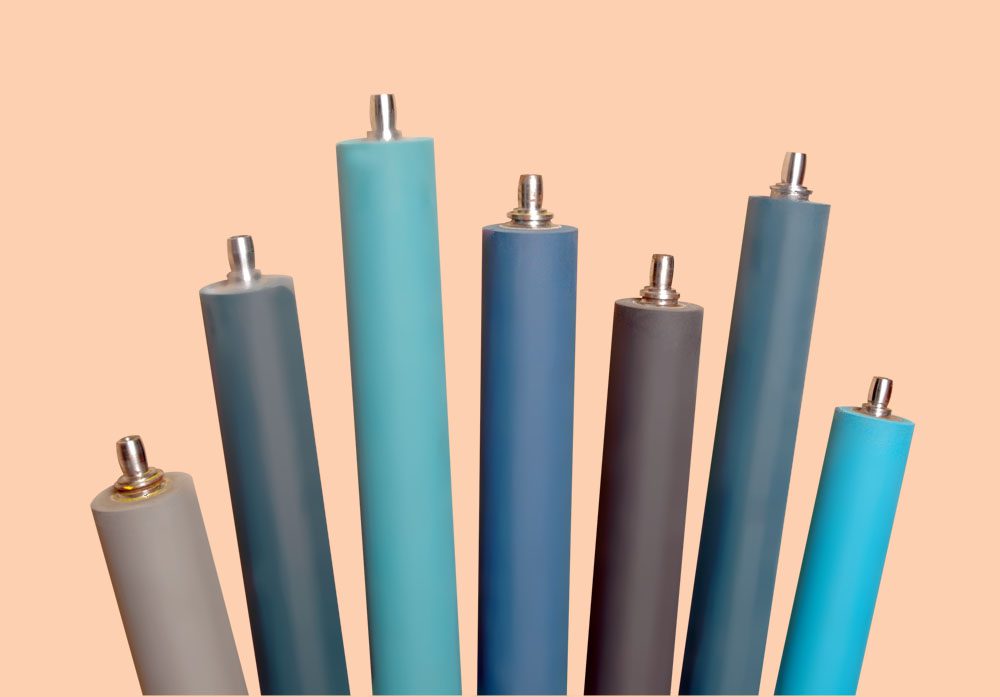
Mechanical Setting: The Importance of Nip Strip Control for Rollers in Offset Printing
The physical contact zone between two interlocking rollers—or between a plate roller and the printing plate—is designated as the nip width.
Proper mechanical adjustment of the nip width is arguably the most critical routine maintenance task on an offset printing press.
When the rollers are set with excessive pressure (too wide nip width),localized frictional heat is generated at the point of contact of the rollers due to the high compression.
This accelerates dynamic softening, swelling and causes rapid mechanical degradation of both the rubber surface and inner core bearings.
Conversely, insufficient pressure (too narrow nip width) leads to ink loss, slippage, and structural streaks on the substrate.
Operators must use physical ink-streaking methods or electronic take-up gauges to set the contact strips evenly across the entire width of the cylinder, strictly following the press manufacturer’s millimeter guidelines.
Advanced Roller Maintenance and Chemical Troubleshooting
During the production cycle, rollers in offset printing machine interact with a continuous influx of ink chemicals, paper fibers, fountain solutions, and washes, leading to common chemical failures:
Deinking (removing ink from the roller): This technical failure occurs when an oleophilic ink roller unintentionally becomes hydrophilic (water-friendly).
This is usually caused by a buildup of surfactants in the fountain solution, desensitization of gum arabic, or paper coatings on the roller surface, which forces the roller to reject ink.
Solving this problem requires in-depth chemical deinking using calcium degreasing pastes and specialized rubber conditioners.
Surface Glazing: Over time, ink carriers, pigments, and aggressive solvents dry within the microscopic pores of the rubber compound, forming a smooth, glassy crust.
Glazed rollers lose tactile friction, leading to uneven ink distribution and increased dot size.
Ongoing maintenance requires alternating between standard VOC washing and deep cleaning with chemical regenerators that open the pores of the rubber.
Calcium Carbonate Contamination: Alkaline paper coatings release calcium into the dampening solution, which deposits a white crystalline layer on the rollers.
This destroys both ink transfer and water metering.
Treatment requires specialized acid washes designed to break down calcium bonds without corroding the underlying polymer matrix of the rubber rollers.
Frequently Asked Questions (FAQ) – Offset Press Rollers
What is the main chemical difference between NBR and EPDM rollers?
NBR (Nitrile Butadiene Rubber) is engineered for conventional oil-based inks and resists typical press washes, but swells rapidly under UV monomers. Conversely, EPDM (Ethylene Propylene Diene Monomer) is built specifically for UV/LED-UV systems to withstand aggressive polar solvents and photoinitiators, but degrades if exposed to conventional mineral oils.
How does dynamic hysteresis affect roller durometer during high-speed production?
Dynamic hysteresis is the internal kinetic friction generated by the rapid, cyclical compression and decompression of the roller rubber compound at high speeds. This creates localized heat buildup which expands the rubber matrix, causing the rollers to soften and lower their active Shore hardness during operation.
Why is setting the correct nip strip width so critical for offset presses?
An excessive nip strip (too much pressure) generates excessive frictional heat, accelerating dynamic softening, swelling, and bearing failure. A nip strip that is too narrow results in ink starvation, roller slippage, and structural streaking. Precise mechanical adjustment ensures uniform micro-granular ink and water transfer.
What causes roller ink stripping and how can press operators fix it?
Ink stripping (roller de-inking) occurs when an inherently oleophilic (oil-friendly) inking roller becomes hydrophilic (water-friendly) and rejects ink. This is caused by the accumulation of fountain solution surfactants, desensitizing gum arabic, or paper coatings. It can be resolved by deep chemical stripping using calcium-degreasing pastes and rubber conditioners.